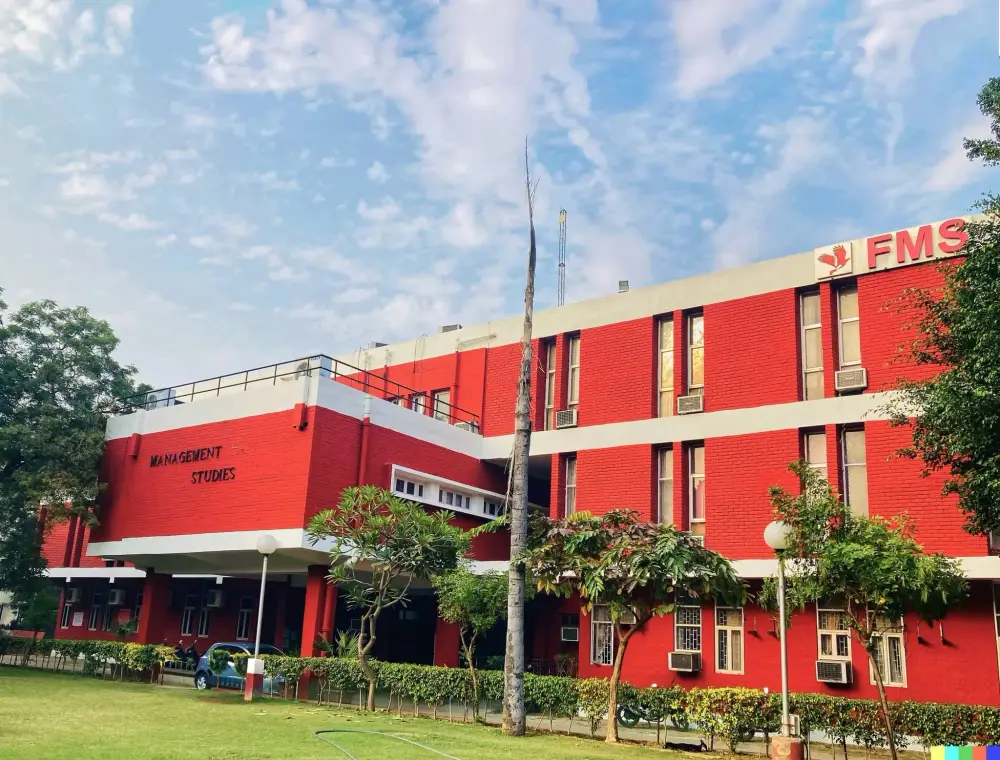

FMS Delhi MBA admission overview
FMS Delhi, the Faculty of Management Studies, is a University of Delhi department founded in 1954 that has run a two-year full-time MBA since 1967, so the degree is a University of Delhi MBA rather than a PGDM. Indian nationals are admitted through CAT alone, with no group discussion: a weighted CAT score (VARC 40%, DILR 30%, QA 30%) decides the interview shortlist, and the final merit adds Class X and XII marks, an SOP discussion, an extempore and a personal interview. For the 2026-28 batch the General shortlisting cut-off was a composite score of 46.739, down from 51.103 a year earlier. There are 251 sanctioned seats. The semester fee in AY2025-26 was ₹60,818 in the first year and ₹57,350 in the second. FMS has no hostel of its own. The 2024-26 batch placed 287 students at a ₹32.27 lakh average and a ₹29.59 lakh median.
Fees, AY2025-26
FMS charges its fee by semester, two semesters a year: in AY2025-26 the full-time MBA fee was ₹60,818 a semester for first-year students and ₹57,350 a semester for second-year students, paid online through the University of Delhi fee portal.
| Category | Per semester: 1st year, Semester II (2025-27 batch) | Per semester: 2nd year, Semester IV (2024-26 batch) |
|---|---|---|
| MBA (full-time) | 60,818 | 57,350 |
| PWD students | 15,205 | 14,338 |
| Orphan quota | 10 | 10 |
| Foreign students, SAARC and Tibet | 2,75,000 | 2,50,000 (one rate for all foreign students) |
| Foreign students, non-SAARC and Tibet | 4,40,000 | |
| MBA (full-time), per year — two semesters, our computed figure | 1,21,636 | 1,14,700 |
Semester II and IV fees were due by 30 January 2026. For Semester III, due by 31 July 2025, the fee was ₹57,350, or ₹14,338 for PWD students and ₹2,71,780 for foreign students.
For the 2026-28 batch the semester fee is approximately ₹60,818, and fees for every programme and category can be revised at any time before or during the programme on University of Delhi instructions. FMS publishes no two-year total. Four semesters at the first-year rate come to ₹2,43,272, our computed estimate; the second-year rate in AY2025-26 was lower, at ₹57,350.
The application fee for 2026-28 was ₹1,000, or ₹350 for SC, ST and PWD candidates; foreign nationals apply through a separate route, explained in the foreign nationals section. To see what a loan against these figures would cost each month, put your own numbers into the college fee EMI calculator.
Hostel and campus
FMS has no hostel of its own. Non-Delhi students of its full-time programmes can apply for a room in one of 11 University of Delhi hostels on North Campus, and allotment is not guaranteed.
| Men | Women |
|---|---|
| V.K.R.V. Rao Hostel | University Hostel for Women |
| D.S. Kothari Hostel | International Hostel for Women |
| Gwyer Hall | North East Council Hostel for Women |
| International Students’ House | Meghdoot Hostel |
| Mansarovar Hostel | — |
| Post-Graduate Men’s Hostel | — |
| Jubilee Hall | — |
FMS publishes no hostel charge, so budget separately for a University hostel or for private accommodation near North Campus. For orphan-quota students, the University Welfare Fund meets the cost of study, including hostel expenditure in the University.
The North Campus library holds more than 40,000 books and journals, including 60 foreign journals, and students can also use the Delhi University Library System, with more than 600,000 books and 8,000 journals, and 27 online databases such as ABI/INFORM and EBSCO. The computer centre has a finance lab with a Bloomberg terminal and the CMIE Prowess database, and both FMS campuses are Wi-Fi enabled.
Seats and reservation, 2026-28
The 2026-28 batch has 251 sanctioned seats, and supernumerary seats outside that count take the total to 289, with another 25 for foreign nationals.
| Category | Seats |
|---|---|
| Unreserved (General) | 101 |
| Other Backward Classes (non-creamy layer) | 69 |
| Scheduled Castes | 37 |
| Economically Weaker Sections | 25 |
| Scheduled Tribes | 19 |
| Sanctioned total | 251 |
| Persons with Disabilities (supernumerary) | 12 |
| Children and widows of armed forces personnel (supernumerary) | 12 |
| Wards of DU teaching staff (supernumerary) | 6 |
| Wards of DU non-teaching staff (supernumerary) | 6 |
| Orphan quota, one male and one female (supernumerary) | 2 |
| Total with supernumerary seats | 289 |
| Foreign nationals (8 SAARC, 17 other countries) | 25 |
- There is no quota for NRI, PIO or NCT of Delhi candidates.
- OBC seats are for the non-creamy layer whose castes appear in the Central List; creamy-layer OBC candidates apply as General.
- The General merit list includes every candidate in merit order, so SC, ST, OBC, EWS, PWD, CW and ward-quota candidates can take General seats.
- OBC (NCL) and EWS certificates must be valid on the interview date and on the date of admission; an expired certificate is not considered.
- You may apply under one of Gen, SC, ST, OBC or EWS together with CW, PWD, WT or WNT, but the category chosen at registration cannot be changed later.
Eligibility
You need a bachelor’s degree taken after twelve years of schooling, with at least 50% marks for the unreserved category, 45% for OBC (non-creamy layer), EWS, PWD and CW candidates, and pass marks for SC and ST candidates, together with a CAT score from the same admission cycle.
Final-year students may apply whatever their marks so far, provided they expect to meet the eligibility criteria and submit their final results before the last date of admission, which was 31 August 2026 for the 2026-28 batch. Applicants graded in CGPA must state the equivalent percentage and supply their university’s official CGPA-to-percentage conversion table. A CAT score from an earlier year is not accepted: applicants who did not take CAT 2025 were not considered for 2026-28. There is no GMAT or GRE route for Indian nationals; that route is only for foreign nationals. SC and ST candidates whose degree is from another university need at least the pass percentage the University of Delhi sets for the equivalent examination.
Selection criteria and weightage
Shortlisting uses a weighted CAT score, VARC 40%, DILR 30% and QA 30%, and the final merit combines that score with academics, an SOP discussion, an extempore and a personal interview; there is no group discussion.
| Component | Weight | How it is scored |
|---|---|---|
| Weighted CAT score | 50% | VARC 40%, DILR 30%, QA 30% |
| Class X marks | 10% | 60% to under 75%: 5 · 75% and above: 10 |
| Class XII marks | 10% | 60% to under 75%: 5 · 75% and above: 10 |
| Discussion on Statement of Purpose | 10% | Individual, for every candidate |
| Extempore | 5% | Individual, for every candidate |
| Personal interview | 15% | Individual, for every candidate |
Women candidates receive five additional marks twice: on the weighted score used for shortlisting, and again at the interview stage. Because the three CAT sections carry different weights, a candidate with a high overall percentile and a weak VARC section can rank below a more balanced candidate with a lower overall percentile, so read your sectional scores against this formula rather than your overall percentile.
Shortlisting cut-off, 2026-28 and 2025-27
FMS publishes its cut-off as a composite score for the interview shortlist: 46.739 for General candidates in 2026-28 (CAT 2025), down from 51.103 in 2025-27 (CAT 2024).
| Category | Seats | Shortlisted, 2026-28 | Cut-off, 2026-28 | Cut-off, 2025-27 |
|---|---|---|---|---|
| General | 101 | 707 | 46.739 | 51.103 |
| OBC | 69 | 483 | 35.189 | 39.154 |
| EWS | 25 | 175 | 37.031 | 40.796 |
| SC | 37 | 259 | 29.370 | 31.887 |
| ST | 19 | 133 | 23.140 | 23.424 |
| PWD | 12 | 84 | 24.247 | 27.304 |
| CW1 | 12 across CW1 to CW5 | 23 | All candidates | All candidates |
| CW2 | 16 | All candidates | All candidates | |
| CW3 | 19 | All candidates | All candidates | |
| CW4 | 11 | All candidates | All candidates | |
| CW5 | 15 | 23.419 | 28.721 | |
| Wards of DU teaching staff (permanent) | 6 | 42 | 22.481 | 21.549 |
| Wards of DU non-teaching staff (permanent) | 6 | 42 | 5.578 | 4.909 |
| Orphan quota, male | 1 | 7 | 26.730 | 38.555 |
| Orphan quota, female | 1 | 7 | 18.172 | 30.449 |
The composite score adds each CAT section score divided by that section’s maximum marks and multiplied by its weight (VARC 40%, DILR 30%, QA 30%), rounded to three decimals, with five extra marks for women. Both years shortlisted 2,023 candidates for 289 seats. This is the score needed to be called for interview, not the score that secured admission: final selection is on the full weighted merit above, and FMS released eleven admission lists for 2026-28 between 21 April and 28 August 2026. Every category with a numeric cut-off fell between the two years except the two ward-quota categories, which rose.
Placements
The 2024-26 batch placed 287 of the 304 students in the placement process at a ₹32.27 lakh average and a ₹29.59 lakh median CTC, with a ₹1.1 crore highest offer.
| Batch | Average | Median | Top-100 average | Highest |
|---|---|---|---|---|
| 2024-26 | 32.27 | 29.59 | 45.19 | 1.1 crore |
| 2023-25 | 30.1 | 30.0 | 43.2 | 1.01 crore (domestic) |
| 2022-24 | 29.2 | 29.0 | 42.1 | 1 crore (domestic) |
| Batch | Students | In placements | Placed | Placement holiday | Companies taking part |
|---|---|---|---|---|---|
| 2024-26 | 307 | 304 | 287 | 3 | 119 |
| 2023-25 | 298 | 294 | 271 | 4 | 90 |
| 2022-24 | 290 | 286 | 268 | 4 | 88 |
| Domain | Pre-placement offers | Other offers | Total |
|---|---|---|---|
| Consulting | 45 | 39 | 84 |
| Product, IT and analytics | 13 | 51 | 64 |
| Marketing | 20 | 39 | 59 |
| Finance | 10 | 49 | 59 |
| General management | 9 | 12 | 21 |
| CTC band | Offers |
|---|---|
| Below ₹20 lakh | 37 |
| ₹20 lakh to ₹24.9 lakh | 35 |
| ₹25 lakh to ₹29.9 lakh | 83 |
| Above ₹30 lakh | 132 |
- 74.9% of the 2024-26 batch received offers above ₹25 lakh.
- The 2021-23 batch averaged ₹34.1 lakh, with a ₹31 lakh median and a ₹46.1 lakh top-100 average, higher on all three than any batch since.
- Students with more than 18 months of work experience went through a lateral process in December 2025; finals for the rest ran in January 2026.
- The number of companies that made offers in 2024-26 is published as both 103 and 99.
- By first degree the 2024-26 batch was 44% engineering, 32.2% BBA, BMS, B.Com or economics, 11.7% sciences and 12.1% other disciplines, and 54% joined as freshers.
- The top 100 students of the 2024-26 batch averaged the 99.69 percentile in CAT and the 99.02 percentile in its quantitative section.
Documents for the interview
Shortlisted candidates bring two passport-size photographs and self-attested copies of the following, together with the originals, to the interview:
- Proof of identity, such as an Aadhaar card, driving licence or voter ID
- Date-of-birth certificate
- Class X and Class XII mark sheets, with the CGPA-to-percentage conversion document where applicable
- Graduation mark sheets, or the latest mark sheets for final-year students, with the conversion document where applicable
- CAT scorecard for the admission cycle
- Reservation certificates where applicable, issued in the candidate’s own name
For EWS claims the names of the applicant and the parents must match those on the school-board certificates. CW claims need an educational concession certificate from an authority such as the Kendriya Sainik Board, a Rajya Zila Sainik Board or the relevant records office, and ward-quota claims need a certificate from the University Registrar or the college principal. Falsified records or false attestation carry a five-year bar from attending any course in the University, and a criminal case.
Admission process and dates
As of 27 September 2026 FMS has not published its bulletin for the 2027-29 batch; CAT 2026 is on 29 November 2026. The 2026-28 cycle ran as follows:
| Step | Date |
|---|---|
| Online registration closed | By 19 January 2026 |
| Shortlisting notice with category cut-offs | 16 March 2026 |
| Interviews begin | 13 April 2026 |
| First admission list and waitlist | 21 April 2026 |
| Eleventh admission list | 28 August 2026 |
| Last date of admission and of withdrawal | 31 August 2026 |
A composite-score cut-off was set for each category, and the 2026-28 interviews were held in person. Registration is online only, through the FMS website, and the registration details cannot be edited once confirmed. All communication is by email to the registered address, and admission lists, cut-offs and waiting lists are posted on the FMS website. No fee is refunded after the last date of withdrawal. In the 2025-27 cycle the shortlist came out on 17 March 2025 and interviews began on 12 April 2025.
Foreign nationals route
Foreign nationals apply for the 25 foreign-student seats, 8 for SAARC countries and 17 for other countries, through the University of Delhi Foreign Students’ Registry at fsr.du.ac.in rather than through CAT.
They must already hold their qualifying degree when they apply, since candidates still studying or awaiting results are not eligible, and they need a certificate that English was the medium of instruction. The test requirement is a GMAT score of 650 or a GRE score of 120, waived for holders of an ICCR scholarship or a scholarship from their own government. Seats do not move between the SAARC and other-country groups. The foreign-student seats are supernumerary, outside the 251 sanctioned seats, and foreign-national admission announcements are posted on the FMS website.
Foreign students pay a separate, higher semester fee, with SAARC and Tibet charged less than other countries in the first year; every rate is listed under Fees.
Common mistakes
| What people assume | What applies |
|---|---|
| The shortlisting cut-off is the admission cut-off | It only decides the interview call; admission is on the full weighted merit, with the interview components worth 30%. |
| The overall CAT percentile decides the shortlist | The composite weights VARC at 40% against 30% each for DILR and QA, so sectional scores matter more than the overall percentile. |
| There is a group discussion | There is none; the SOP discussion and extempore are individual. |
| Last year’s CAT score can be reused | Only the current cycle’s CAT counts; CAT 2024 scores were not considered for 2026-28. |
| The category can be corrected after registering | It cannot; register under the right category with a valid certificate ready. |
| An OBC or EWS certificate that expires before admission is fine | It must be valid on the interview date and on the date of admission. |
| FMS has its own hostel, or Delhi residents get a quota | Neither: accommodation depends on DU hostel allotment, and there is no NRI, PIO or Delhi quota. |
How FMS Delhi compares
FMS charges a University of Delhi semester fee, and its 2024-26 median CTC of ₹29.59 lakh is close to MDI Gurgaon’s ₹29.0 lakh for a PGDM costing ₹26,55,310; the trade-offs are no hostel and 101 General seats, for which 707 candidates were shortlisted in 2026.
| Institute | Fee | 2024-26 median CTC | Admission |
|---|---|---|---|
| FMS Delhi (MBA) | ₹60,818 a semester, first year (AY2025-26) | ₹29.59 L | CAT, weighted score and interview |
| MDI Gurgaon (PGDM) | ₹26,55,310 for two years with hostel (2027-29) | ₹29.0 L | CAT; GMAT only for PGDM-IB and NRI applicants |
| JBIMS Mumbai (MMS) | ₹4,34,289, Open category (AY2026-27) | ₹26.15 L | MAH-MBA/MMS CET and CAP |
Against MDI Gurgaon, the choice is between a residential campus with hostel and mess built into a ₹26,55,310 fee and a University of Delhi fee with accommodation left to the student. JBIMS Mumbai, an institute of the University of Mumbai, also has a low fee, but it admits through the Maharashtra CET process rather than CAT. For other options, see our MBA admission guide.
Frequently asked questions
What is the MBA fee at FMS Delhi?
In AY2025-26 the full-time MBA semester fee was ₹60,818 for first-year students and ₹57,350 for second-year students; PwBD students paid ₹15,205 and ₹14,338. For the 2026-28 batch the semester fee is approximately ₹60,818 and can be revised at any time on University of Delhi instructions. FMS publishes no two-year total; four semesters at ₹60,818 would be ₹2,43,272, our computed estimate.
What is the FMS Delhi cut-off?
FMS publishes a shortlisting cut-off as a composite score, not a CAT percentile. For the 2026-28 batch (CAT 2025) the General cut-off was 46.739, OBC 35.189, EWS 37.031, SC 29.370, ST 23.140 and PWD 24.247. For 2025-27 (CAT 2024) General was 51.103. It is the score needed for an interview call, not the score that secured admission.
How is the FMS composite score calculated?
Each CAT section score is divided by that section’s maximum marks and weighted: VARC 40%, DILR 30% and QA 30%. The weighted parts are added and rounded to three decimals, and women candidates get five extra marks. The same weighted CAT score then counts for 50% of the final merit, alongside Class X, Class XII, an SOP discussion, an extempore and a personal interview.
Is there a group discussion at FMS Delhi?
No. After shortlisting, each candidate faces an individual discussion on their Statement of Purpose (10%), an extempore (5%) and a personal interview (15%). With the weighted CAT score (50%) and Class X and XII marks (10% each), that makes up the final merit. Women candidates who appear for the interview receive five additional marks.
What were FMS Delhi placements for 2024-26?
The 2024-26 batch of 307 had 304 students in the placement process and 287 placed. The average CTC was ₹32.27 lakh, the median ₹29.59 lakh, the top-100 average ₹45.19 lakh and the highest ₹1.1 crore. Consulting took 84 offers, product, IT and analytics 64, marketing 59, finance 59 and general management 21.
How many MBA seats does FMS Delhi have?
251 sanctioned seats for 2026-28: Unreserved 101, OBC 69, SC 37, EWS 25 and ST 19. Supernumerary seats add 12 for PWD, 12 for children and widows of armed forces personnel, 6 each for wards of DU teaching and non-teaching staff and 2 for orphans, taking the total to 289. Another 25 seats are for foreign nationals.
Does FMS Delhi have a hostel?
No. Non-Delhi students of FMS’s full-time programmes can apply for a room in one of 11 University of Delhi hostels on North Campus: seven for men, four for women. Allotment is not guaranteed and FMS publishes no hostel charge, so budget for private accommodation in Delhi as a fallback.
Is there an NRI, PIO or Delhi-domicile quota?
No. There is no quota for NRI, PIO or NCT of Delhi candidates. Indian-national seats go by the reservation categories in the seat matrix, and the general merit list includes reserved-category candidates who rank high enough. The category you choose at registration cannot be changed later in the process.
Can foreign nationals apply to the FMS MBA?
Yes, through the University of Delhi Foreign Students’ Registry (fsr.du.ac.in), not CAT. Applicants need a completed bachelor’s degree, English as the medium of instruction, and a GMAT score of 650 or a GRE score of 120; ICCR and home-government scholarship holders are exempt from the test requirement. There are 25 seats: 8 for SAARC countries and 17 for others.
When does FMS admission for the 2027-29 batch open?
As of 27 September 2026 FMS has not published its bulletin for the 2027-29 batch. For 2026-28, online registration had closed by 19 January 2026, the shortlist came out on 16 March 2026, interviews began on 13 April 2026, and the last date of admission was 31 August 2026. CAT 2026 is on 29 November 2026.
Is FMS Delhi an MBA or a PGDM?
An MBA. FMS is a faculty of the University of Delhi, so its full-time programme leads to a University of Delhi MBA degree rather than a postgraduate diploma. FMS started as part of the Delhi School of Economics in 1954 with an evening master’s programme and began its full-time MBA in 1967.
Contact & address
Faculty of Management Studies (FMS), University of Delhi, Malkaganj Marg, Kamla Nagar, New Delhi 110007 · Admissions: [email protected] · Tel: 011-2766 6382, 6383, 6384 · Web: www.fms.edu.
📋 Data Accuracy Notice (September 2026)
- Verification: Recheck live fees, cut-offs, dates, vacancies and refund rules on the competent authority or institute website before applying, locking choices or paying.
- Corrections: We keep unknown figures unfilled instead of replacing them with third-party estimates. Report an error to [email protected].
- Platform status: Future Career Guidance is an independent admission counselling service. Listing a college does not imply affiliation, authority to allot a seat or a placement guarantee.